 English
 العربية
 bosanski jezik
 Български
 Català
 粤语
粤语 中文(漢字)
 Hrvatski
 Čeština
 Dansk
Dansk Nederlands
 Eesti keel
 Suomi
Suomi Français
 Deutsch
 Ελληνικά
 עברית
עברית Magyar
 Italiano
 日本語
日本語 한국어
한국어 Latviešu valoda
 Bahasa Melayu
 Norsk
Norsk پارسی
پارسی Polski
 Português
 Română
 Русский
 Cрпски језик
 Slovenčina
 Slovenščina
 Español
 Svenska
 தமிழ்
தமிழ் ภาษาไทย
 Tiếng Việt

Kaedah reka bentuk abah EB dan proses pemasangan boleh dilaksanakan secara sistematik dalam kombinasi dengan fungsi perisian dan keperluan proses, seperti berikut:
1. Kaedah reka bentuk abah EB
Konfigurasi modular dan pengurusan berbilang konfigurasi
Tentukan penyelesaian berbilang litar melalui pilihan konfigurasi modul EB Cable, menyokong keperluan reka bentuk abah-abah dengan konfigurasi yang berbeza, dan menjana secara automatik 150% gambar rajah abah-abah berbilang konfigurasi.
Gunakan perkaitan logik antara pilihan konfigurasi untuk memastikan ketekalan reka bentuk, seperti memadankan konfigurasi kenderaan dengan spesifikasi abah-abah.
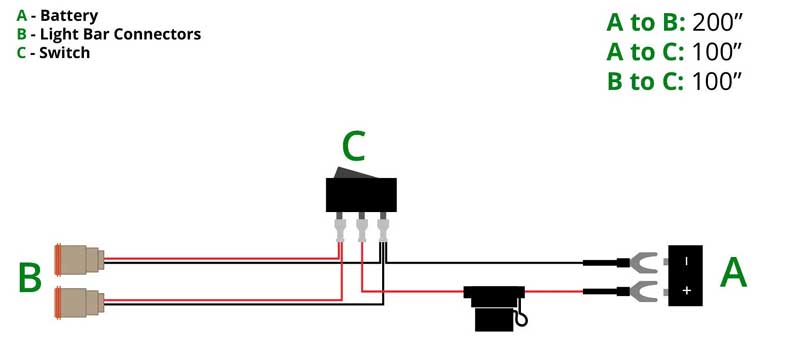
Garis Panduan Pemasangan Komponen dan Susun Abah Kabel – Abah-abah Pendawaian Luar Jalan 2-Pin Dwi Output
Penyuntingan topologi dan perataan 2D
Ratakan struktur abah-abah 3D melalui antara muka perisian 3D atau editor topologi manual untuk menjana lukisan 2D, mengoptimumkan susun atur cawangan dan pengiraan panjang.
Support branch direction definition (such as north, south, west, east, dll.) to improve wiring logic and readability.
Accessory and mounting rail association design
Use the accessory assistant to define the installation form and direction of the device and accessories, such as the associated installation of the motor protection switch and auxiliary contacts1.
The mounting rail allocation assistant automatically generates component layout based on the accessory configuration to reduce manual intervention.
Automatically generate production documents
Based on EB’s central database, quickly export component lists, cable lists and wiring tables to ensure that design and production data are consistent.
2. Key processes of wiring harness assembly Sub-material number production and inspection
Cut the wire size according to the positioning plate to avoid resource waste caused by size deviation, and ensure the quality of sub-material numbers through electrical testing and full inspection.
Wiring and branch management
Wiring is divided according to the drawings, and a single area is processed first and then cross-regional branches are processed, following the order from simple to difficult36.
The trunk branch needs to consider the tolerance (±5mm~±10mm) and the bending radius (≥2 times the harness diameter), and the process size is reserved to deal with assembly errors.
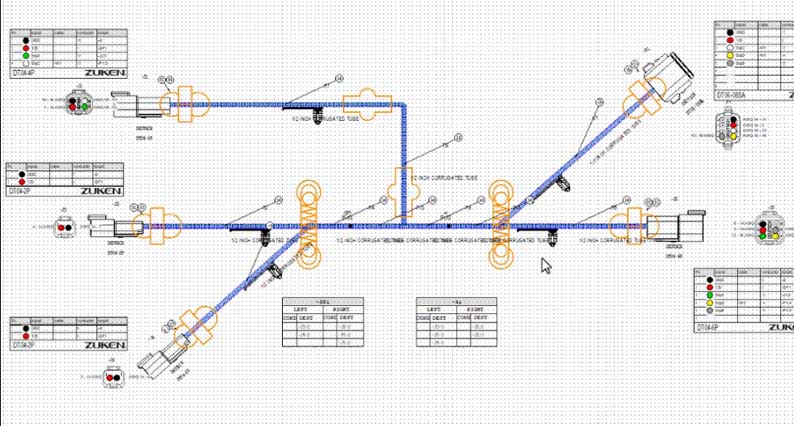
Software Aids Harness Design – Wire Harness Assembly, A Complete Guide to Types, Faedah, Manufacturing
Plug-in and fixing process
Perform the three steps of plug-in (push, listen, and pull back) to ensure that the terminal is in place and the connection is reliable7.
Use special tools to install bellows, sheaths and positioning parts to avoid damage or loosening of the harness78.
Testing and Inspection
The electrical test bench verifies the correctness of the circuit, and checks the terminal tolerance, wire binding uniformity and component assembly compliance in combination with the full inspection process.
High-voltage wire harnesses require extra attention to shielding performance (such as metal shell design, shielding ring) and dust and water resistance (above IP67).
3. Design-Assembly Collaborative Optimization
Data consistency: EB design data directly drives assembly process files (such as wiring tables, terminal diagrams), reducing information transmission errors.
Design for Manufacturability (DFM): Combined with EB’s configuration management function, assembly tolerances and process dimensions are reserved in the design stage to reduce rework rates.
Through the above methods, EB software can achieve a digital closed loop from design to assembly, improving the efficiency and quality of wire harness engineering.
In order to solve various problems in wire harness design, professional wire harness design software came into being. After years of development, the most widely used professional wire harness design software in the automotive industry currently include EB Cable from AUCOTEC of Germany and Capital (CHS) daripada Grafik Mentor Amerika Syarikat. Kedua-dua produk mempunyai fungsi yang berkuasa dan mempunyai sejumlah besar kumpulan pelanggan di pasaran domestik dan asing. Ia boleh dipanggil alat abah-abah pendawaian arus perdana.
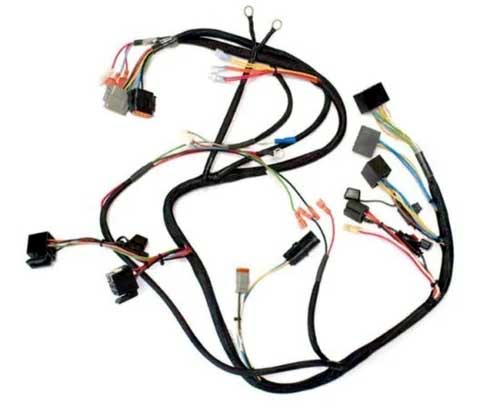
Prototaip dan Pembuatan Pemasangan Abah-abah Wayar Tersuai China
Kabel dan Modal EB (CHS) kedua-duanya direka dan dibangunkan khusus untuk abah-abah wayar. Dengan seni bina perisian dan konsep reka bentuk yang serupa, ia boleh menyelesaikan semua kerja pada abah-abah pendawaian automotif daripada reka bentuk prinsip kepada reka bentuk abah-abah pendawaian 2D.
Kedua-dua EB Cable dan Capital (CHS) perisian mempunyai ciri-ciri berikut:
1. Gunakan pangkalan data pusat untuk mengurus semua data
2. Dilengkapi dengan pangkalan data bahagian, yang boleh menyimpan simbol dan data bahagian
3. Mempunyai keupayaan reka bentuk kolaboratif, dengan beberapa jurutera bekerja pada projek yang sama pada masa yang sama
4. Selepas reka bentuk siap, pelbagai bentuk dijana secara automatik
5. Data boleh dipindahkan secara automatik semasa peringkat reka bentuk yang berbeza. Data reka bentuk skematik tidak perlu ditakrifkan berulang kali dalam rajah abah-abah pendawaian, menjimatkan banyak kerja.
Modular (KSK) reka bentuk boleh dicapai
6. Mempunyai antara muka data dengan perisian reka bentuk 3D
7. Boleh menyelesaikan beberapa masalah dalam proses pengeluaran
Penulis hanya menggunakan EB Cable atas sebab kerja, jadi saya akan kongsikan secara ringkas di bawah. Rajah di bawah ialah carta alir reka bentuk Kabel EB.
rajah skema sistem SYS
Reka Bentuk Prinsip Sistem Kabel EB ialah alat reka bentuk skema sistem profesional yang mudah dipelajari dan mudah digunakan berdasarkan ciri elektrik. Sebarang objek elektrik dalam reka bentuk boleh dikenali oleh perisian, and all electrical objects can be assigned material numbers. The connection of electrical objects is a physical connection.
The tree-like directory structure is convenient for browsing and querying, and the symbol library established in the symbol library can be directly called for drawing. Shortcut keys can be used to quickly position and zoom objects in the design. Mouse zoom, pan, and stroke commands are supported, making the operation simple and fast.
KAB wiring schematic diagram
The wiring schematic diagram is automatically generated based on the original system schematic diagram, the electrical component connectors are automatically generated, the wires are automatically generated, and the terminals, waterproof plugs and other accessories in the connectors are automatically generated.
2D wiring harness diagram design
EB menggunakan data reka bentuk yang dilengkapkan dalam rajah skematik (termasuk penyambung, sambungan wayar, pengedap dan konfigurasi terminal, dll.) untuk melakukan paparan abah-abah wayar dua dimensi. Dalam proses ini, data yang ditakrifkan dalam rajah skema tidak perlu ditakrifkan semula. Oleh itu, untuk reka bentuk abah-abah dawai dua dimensi, anda hanya perlu mentakrifkan maklumat seperti topologi abah-abah wayar, panjang cawangan, gesper dan pembalut, dan meja litar, penyambung, Buckles, pembalut dan jadual lain boleh dijana secara automatik. Kira panjang wayar secara automatik, diameter cawangan dan maklumat lain, dan semua bahan termasuk terminal, anjing laut, dll. boleh dilihat dan dikeluarkan melalui lembaran kerja.4. Gabungkan model abah-abah wayar 3D melalui HIM Pro
HIM Pro boleh merealisasikan interaksi data antara EBCable dan CATIA. Melalui antara muka, 3D wire harness data can be imported to automatically generate 2D wire harness diagrams, reducing repetitive manual drawing work. Pada masa yang sama, information such as branch length in 3D design is fed back to EBCable, so that 2D wire harness design can obtain accurate wire harness branch length.
The three-dimensional data interactive interface provided by EB Cable is easy to operate and can intuitively display the differences between 3D and 2D wire harness design data. The interactive interface can scan and display 3D wire harness definition error prompts in real time, and objects in the CATIA 3D wire harness can be directly located from the prompts in the interactive interface, making it easier for engineers to quickly check design data and locate design errors.
The author himself summarizes several useful aspects of EB Cable based on his own actual experience:
1) Device library management function
• Device libraries can be quickly created in batches through Excel/CSV import.
• Devices can establish a one-to-one correspondence with symbols, and the same device can be equipped with multiple preferred symbols.l
• When engineers select devices, a warning will be issued if the device exceeds the company’s commonly used device library.
2) Table output function
• All data can be opened in the worksheet for unified management or viewing, and the worksheet operation is simple;
• All worksheets can be inserted into drawings or exported to Excel tables;
• Engineers can quickly locate the corresponding object through the search and link jump functions of the worksheet
• The worksheet provides a variety of data statistics functions to facilitate engineers to collect data
3) Data real-time link
Design data is correlated in real time at all stages of the EB Cable design process. When one data change occurs in the schematic diagram, wiring harness diagram, and statistical report, other related data will automatically change;
4) Three-dimensional interface HIM
• In the 3D wire harness design stage, the 3D interface HIM can be used to scan 3D wire harness data. The interface automatically counts and prompts errors in the three-dimensional wire harness design, and the three-dimensional wire harness can be quickly located and modified through the interface. The operation is very convenient and can avoid the transmission of 3D definition errors to the 2D wire harness design;
• Import the wire harness data in EB Cable into the 3D design, perform 3D wiring, and import the 3D design data to automatically generate a 2D wire harness diagram;
• After the wire harness design in EB Cable is completed, the diameter of each branch can be automatically calculated based on the thickness of the wires in the branch. The interface program can return branch diameter information to the 3D wire harness design and automatically update the thickness of the branches in the 3D design;