 English
 العربية
 bosanski jezik
 Български
 Català
 粤语
粤语 中文(漢字)
 Hrvatski
 Čeština
 Dansk
Dansk Nederlands
 Eesti keel
 Suomi
Suomi Français
 Deutsch
 Ελληνικά
 עברית
עברית Magyar
 Italiano
 日本語
日本語 한국어
한국어 Latviešu valoda
 Bahasa Melayu
 Norsk
Norsk پارسی
پارسی Polski
 Português
 Română
 Русский
 Cрпски језик
 Slovenčina
 Slovenščina
 Español
 Svenska
 தமிழ்
தமிழ் ภาษาไทย
 Tiếng Việt

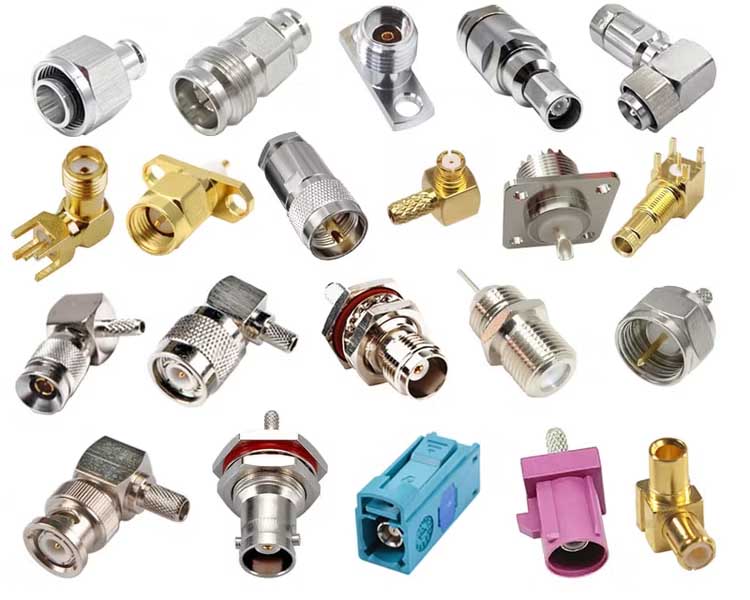
Das benannte Modell des RF TNC / BNC / QMA / SMB / SMC /DIN /FME -Anschluss befindet sich im Allgemeinen vom international anerkannten Hauptnamenmodell. Die Namensnamenmodelle verschiedener Produkte verschiedener Produkte sollten gemäß detaillierten Standards und Spezifikationen formuliert werden. Wie viel wissen Sie über die Grundlagen von HF -Anschlüssen??
China custom BNC Male to SMA Male RF Coaxial Connector Cable Assembly with Rg58 Cable – Cable Assembly
RF coaxial connector development
The invention of RF and microwave coaxial connectors dates back to the 1940s during World War II. With the birth of radar and various radio communication equipment, connectors such as N and BNC first appeared.
With the development of radar, radio and microwave communication, N, C, TNC, and other series have been produced. After 1958, miniaturized products such as SMA, SMB, and SMC appeared. In 1964, the US military standard MIL-C-39012 “General Specification for Radio Frequency Coaxial Connectors” was formulated. From then on, RFC began to develop in the direction of standardization, serialization, and generalization, so the earliest development started from the military engineering department.
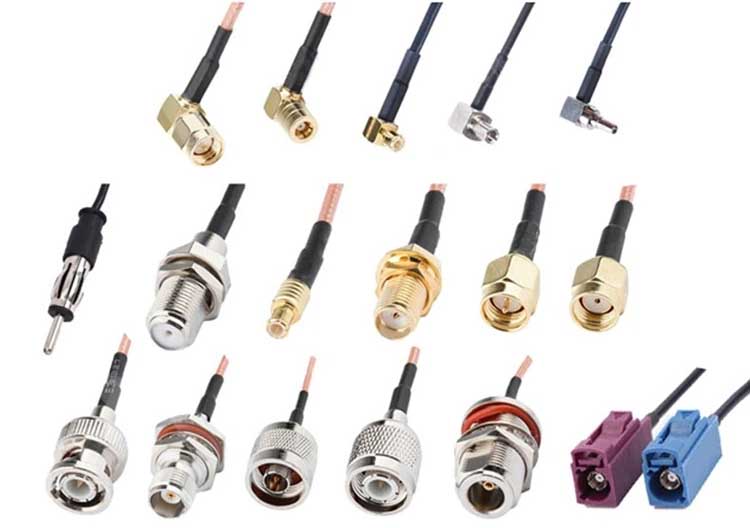
China Custom QMA Female für SMA SMB SMC N UHF BNC TNC FME F MCX MMCX CRC9 TS9 RG316 COAX CAIL
Der N-Typ-Stecker hat seinen Ursprung in 1942 und ist nach seinem Erfinder benannt, Paul Neill. Die anfängliche Arbeitsfrequenz betrug 4 GHz, und nach den 1960er Jahren wurde es auf 11 GHz verbessert. Der Präzisionstyp kann bis zu 18 GHz arbeiten, und es ist einer der am häufigsten verwendeten Steckverbinder. Es gibt zwei Spezifikationen: 50 Ω und 75 Ω, die nicht miteinander verbunden werden können. Der Innendurchmesser des Außenleiters beträgt 7 mm. Typ N ähnelt dem chinesischen Standard L16, Die beiden sind jedoch nicht kompatibel und erfordern einen speziellen N-L16-Adapter.
BNC ist der älteste Hochfrequenz-Koaxialstecker, während des Zweiten Weltkriegs. Aufgrund der dringenden Bedürfnisse des Krieges, Verschiedene Arten von elektronischen Geräten an Bord und in der Luft wurden beschädigt, Dies führte zu großen Schäden an den zu reparierenden US-Marine- und Luftkampfwaffen. In order to shorten the repair time, the U.S. Department of the Navy gathered some excellent researchers and engineers to invent the quick mating and separation connector BNC in a short period of time, which became a plug-in N-type connector. It is the originator of RF coaxial connectors all over the world. Commonly used in low-frequency circuits, the inner diameter of the outer conductor is 6.5mm. Similar to the Chinese standard Q9, but not fully compatible.
TNC is an acronym for Threaded Neill–Concelman. Do you see Neill-Concelman familiar? By the way, the NC of TNC is the same as the NC of BNC, that is to say, they have the same inventor. The TNC connector is a variant of the BNC connector and an improved version of the BNC, and its frequency characteristics are basically the same as those of the N-type. The TNC uses a threaded connection.
The APC/7mm connector (Amphenol Precision Connector) originated in the 1960s. Amphenol standard, non-polar, is the lowest standing wave among all connectors up to 18GHz, commonly known as “flat connector”. Commonly found in network analyzers. Der Innendurchmesser des Außenleiters beträgt 7 mm.
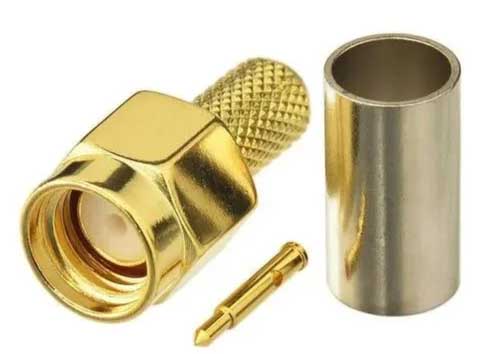
Custom SMA Connector RF Coaxial SMA-C-J1.5 Straight Male Head Inner Screw Inner Hole for RG316 RG174 Cable Connectors
The HN-type connector is a high-voltage version of the N-type connector introduced in the 1950s. It can work up to a voltage of 5kV, and its size is close to N-type, but its power capacity is larger.
The DIN7-16 connector (Deutsche Industries Norm) is derived from the 6-16 (60Oh) connector invented by Spinner. Der Außendurchmesser des Innenleiters beträgt 7 mm, und der Innendurchmesser des Außenleiters beträgt 16 mm, welches der Stecker mit der besten passiven Intermodulation ist (PIM) Leistung zwischen allen Anschlüssen. Kommt häufig in Mobilfunk-Basisstationen und Fernsehsendern vor. Kompatibel mit dem chinesischen Standard L29.
SMA wurde Ende der 1950er Jahre von Bendix für halbstarre Koaxialkabel entwickelt. Sein passender Raum ist mit Polytetrafluorethylen-Medium gefüllt, und seine Struktur ist relativ einfach. Dieser Steckverbinder war für eine längere Verwendung nicht vorgesehen, geschweige denn als Präzisionsstecker betrachtet, es handelt sich also nur um einen Connector für gängige Systeme. Aber es ist wahrscheinlich der am weitesten verbreitete Steckverbinder der Welt.
3.5mm-Anschluss: Mitte der 1960er Jahre, the U.S. Das Handelsministerium richtete einen Joint Industry Research Council ein (JIRC) for the standardization of small precision coaxial connectors. After efforts to propose a civilian product standard in 1972, the size of the air transmission line was reduced to 3.5mm, and the frequency under the modeless working state was extended to 36GHz. Jedoch, due to its high precision and high price, it has been hindered from being widely used as a general connector. Due to the needs of the situation, companies such as Hewlett-Packard have developed a high-precision, relatively cheap 3.5mm connector. Add a non-slotted protective cover on the outside. Rated operating frequency up to 33GHz. The 3.5mm connector is compatible with SMA and can be docked without loss. In the SMA working frequency range, the VSWR characteristics of the 3.5mm connector are similar to those of the SMA. The 3.5mm connector is especially suitable for test equipment due to its precision and good wear resistance.

Choosing the Right Connector-A Guide to BNC, TNC, SMA, MCX, MMCX, and IPEX-U.FL at China
The 2.92mm connector is similar to the 3.5mm connector in structure, but it is smaller, allowing the operating frequency to 46GHz, and its inner conductor size is the same as SMA at 0.05 Zoll (1.27mm). The 2.92mm connector was first developed by Maury Microwave (MPC-3 type). Such connectors developed by other companies include K-type, KMC-type, WMP4-type, usw.
The K-type connector was developed by Wiltron in 1983 (Wiltron was acquired by Japan’s Anritsu in 1990), and it is compatible with SMA, 3.5mm, and WSMA connectors. The heart of the K-type connector is its transition device, which uses a glass insulator to realize the rigid transition from the coaxial connector to the microstrip circuit, which ensures that the circuit will not be damaged when the connector is replaced or repaired.
The 2.4mm coaxial connector was invented by Julius Botke and Paul Watson in 1986 and is compatible with 1.85mm connectors. Also known as OS-50 type, the inner diameter of the outer conductor is 2.4mm. The successful development of the 2.4mm coaxial connector marks a new step in the development of millimeter wave connectors. A series of small coaxial connectors developed in front of it have made many improvements in structure, but the robustness and repeatability of the connectors are still not improved enough. This creates a cascade of problems with instrumentation and calibration standards, where greater alignment, robustness, and repeatability are required.
The 2.4mm connector can be used in a wide range of fields, and it is the first product with three grades: Produktionsqualität, instrument grade and measurement grade.
1.85 and 1.0mm connectors; Hewlett-Packard Company of the United States is a manufacturing company engaged in electronic equipment and components, and it has been in a leading position in the development of millimeter wave connectors. At the European Microwave Conference in 1986, they introduced the 1.85mm connector for the first time, extending the working frequency to 65GHz. Später, Wittron Company (Wiltron Company was acquired by Japan’s Anritsu in 1990) was improved and announced in January 1989 that the 1.85mm (V-type) connector was used in the 360-type network analyzer, and it was compatible with the 2.4mm connector. The structural form of the V-type connector is the same as that of the K-type, but the size is smaller. It is also connected to the microwave circuit with a transition – a glass insulator whose center conductor is only 9 mils (0.23mm) in diameter.
The 1.35mm connector will be launched around 2020 by the German National Institute of Metrology, the German Federal Institute of Physics and Technology, Rohde & Schwarz, Rosenberg High Frequency Technology and SPINNER.
In the 1990s, Hewlett-Packard announced that they had successfully developed a 1.0mm connector with an inner conductor diameter of about 0.43mm (50Oh) and a maximum operating frequency of 110GHz, which is a top microwave connector.
The 0.8mm connector is currently the world’s smallest millimeter-wave top connector. The 0.8mm and 1.0mm connectors have some similarities, haben ähnliche Strukturabmessungen, und haben ein ähnliches Aussehen. Aber das Innere der beiden ist ganz unterschiedlich. Obwohl die Technologie des 1,0-mm-Steckers als Referenz verwendet werden kann, Der 0,8-mm-Stecker benötigt noch einige neue Designs, um eine bessere Leistung zu erzielen.
Zum Beispiel, Das Breitband-Vektornetzwerk der ME7838D-Serie der Anritsu Company verwendet einen 0,8-mm-Koaxialkalibrator.