 English
 العربية
 bosanski jezik
 Български
 Català
 粤语
粤语 中文(漢字)
 Hrvatski
 Čeština
 Dansk
Dansk Nederlands
 Eesti keel
 Suomi
Suomi Français
 Deutsch
 Ελληνικά
 עברית
עברית Magyar
 Italiano
 日本語
日本語 한국어
한국어 Latviešu valoda
 Bahasa Melayu
 Norsk
Norsk پارسی
پارسی Polski
 Português
 Română
 Русский
 Cрпски језик
 Slovenčina
 Slovenščina
 Español
 Svenska
 தமிழ்
தமிழ் ภาษาไทย
 Tiếng Việt

Analisi e contromisure del problema rottura del freno di stazionamento elettronico (EPB) cablaggio di collegamento
IO. Cause di rottura
Materiali e progettazione strutturale insufficienti
Il materiale del filo ha una granulometria troppo bassa o la guaina protettiva esterna ha una velocità volumetrica troppo elevata, con conseguente prestazione insufficiente di fatica anti-flessione.
Il numero di nuclei del cablaggio è troppo piccolo, e lo stress a lungo termine tende a causare il rischio di rottura.
Luogo di installazione e impatto ambientale
Il cablaggio EPB è installato principalmente nella zona delle sospensioni del telaio del veicolo, che è suscettibile agli impatti esterni, vibrazioni o sollecitazioni di flessione.
L'esposizione a lungo termine ad alte temperature e ad ambienti umidi può accelerare l'invecchiamento dell'imbracatura, causing the insulation layer to become brittle or the metal wire to corrode and break.
Mechanical fatigue and use loss
Repeated bending, stretching and other actions during vehicle driving may cause fatigue and fracture of the wire inside the harness.
The harness connector is loose or improperly fixed, exacerbating local stress concentration.
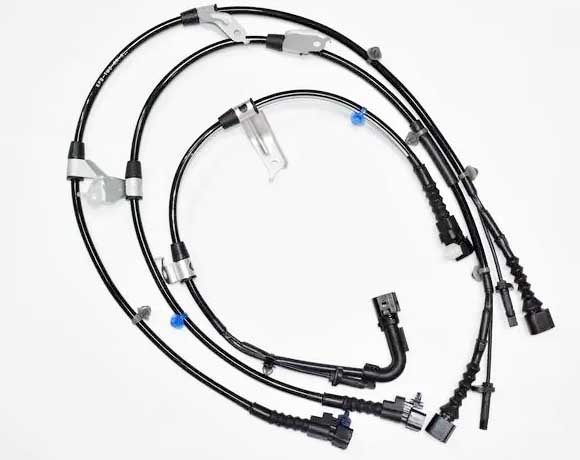
Freno di stazionamento elettrico (EPB) cablaggio
EPB Not Releasing:
The EPB may not release after being engaged, causing the vehicle to remain stationary.
Malfunction Indicator Lamp (Mil):
A warning light on the dashboard may indicate a problem with the EPB system.
Service Messages:
The car’s display may show messages related to the EPB system failing or requiring service.
Loose or Damaged Harness:
Inspect the wiring harness for any signs of damage, like fraying, fili spezzati, or corrosion.
Loose Connections:
Check for loose connections in the harness, especially at the connectors.
Troubleshooting and Repair:
Ispezione visiva:
Carefully examine the wiring harness along the EPB module, including the connectors and wires.
Continuity Test:
Use a multimeter to test the continuity of the wires in the harness. If there’s a break in the circuit, the multimeter will show a high resistance or an “OL” (out of limits) reading, according to Advance Auto Parts.
Connector Replacement:
If a connector is damaged or corroded, consider replacing it with a new one, according to the National Highway Traffic Safety Administration (.gov).
Harness Replacement:
If the harness is extensively damaged, replacing the entire harness may be necessary.
Professional Assistance:
If you’re unsure about diagnosing or repairing the harness, it’s best to consult a qualified mechanic.
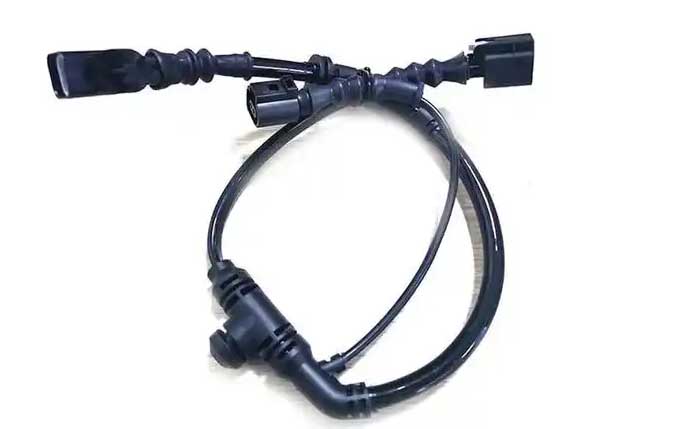
Electric Parking Brake (EPB) & Auto Hold not working & EPB Auto Hold Parking brake light bilgking
Ii. Solution
Optimize the harness structure and material
Increase the grain size of the copper conductor, increase the number of cores, and reduce the volumetric rate of the protective sheath to enhance the anti-bending ability. Use a multi-layer shielding structure or flexible sheath material to reduce the direct effect of external stress on the wire.
Replace or repair broken harnesses Check the break point of the harness, repair or replace the damaged part, and ensure that the connector is stable and has no poor contact. Professional detection and system reset Use a diagnostic instrument to read the EPB system fault code, confirm the harness-related fault and perform a software reset. If the break causes signal transmission interruption, the system parameters need to be recalibrated through the ECU.
Iii. Preventive measures Regular inspection and maintenance Focus on checking the fixing status and appearance integrity of the chassis harness to avoid damage caused by looseness or friction. Optimize design and installation process In the vehicle design stage, plan the direction of the harness reasonably, avoid high-frequency vibration areas, and adopt anti-bending redundant design. Avoid excessive bending and external force impact Reduce the mechanical load on the harness during sharp turns and bumpy roads in daily use to extend the service life
Se il problema non può essere risolto con mezzi convenzionali, si consiglia di contattare un'organizzazione di manutenzione professionale per ispezioni e riparazioni sistematiche per evitare rischi per la sicurezza causati dal funzionamento autonomo.
Mira al problema della rottura del cablaggio EPB di un'automobile nel test di flessione simulato del veicolo reale. In questo articolo, Gli ingegneri dei cablaggi analizzano in modo completo i fattori relativi alla frattura del filo, e combinare metodi di analisi sperimentale per analizzare e valutare l'affidabilità dei cavi del cablaggio EPB automobilistico contro la frattura da fatica da flessione. Vengono proposte diverse soluzioni e ne vengono studiati gli effetti di implementazione. I risultati mostrano che è più pratico ottimizzare la dimensione dei grani del conduttore di rame e la struttura del filo, aumentare il numero di fili centrali, e ridurre il rapporto volumetrico della guaina protettiva esterna del filo. Può ridurre efficacemente la probabilità di rottura del cablaggio EPB dell'automobile.
0 Prefazione
Con il rapido sviluppo dell'industria automobilistica, La sicurezza automobilistica è il primo indicatore della progettazione e della produzione automobilistica. Utilizzando tecnologie moderne e mezzi avanzati, vari modi e soluzioni possibili per migliorare ulteriormente la sicurezza possono rendere più sicuro l'auto come mezzo di trasporto. Come sistema frenante, il sistema PEB è un importante sistema di sicurezza e un fattore importante nella misurazione degli standard di sicurezza automobilistica. L'ampia applicazione dei sistemi di parcheggio elettronici EPB nelle automobili svolge un ruolo importante nel miglioramento della sicurezza e del comfort di guida delle automobili. Il cablaggio EPB è parte integrante del sistema, and its reliability directly affects the reliability of the entire automotive EPB system. This article mainly studies the reliability of automotive EPB wire harnesses against bending and fracture.
As part of the automotive wiring harness, the automotive EPB wire harness integrates EPB wires and ABS wires and is installed in the suspension area of the body chassis. This part is subject to both impact and corrosion from the outside of the car body, as well as a large amount of mechanical movement from the longitudinal swing arm. Perciò, PEB places high requirements on the bending resistance of the wire harness. When the car is driving due to uneven road conditions, l'oscillazione del braccio oscillante longitudinale nel sistema di sospensione del telaio della carrozzeria spinge il cablaggio EPB in una flessione continua ad alta frequenza, causando la piegatura e la rottura dei fili in questa sezione. Questa modalità di errore è al centro di questo articolo.
Figura 1, ambiente di lavoro del cablaggio EPB automobilistico e struttura del sistema EPB
EPB automobilistico (Freno di stazionamento elettrico) system è l'abbreviazione di sistema di parcheggio elettronico. Sostituisce il tradizionale freno a mano a leva ma è più sicuro e non modifica l’effetto frenante grazie alla forza del conducente. Trasforma il tradizionale freno a mano a leva in un pulsante a portata di mano. È una tecnologia che realizza il freno di stazionamento tramite controllo elettronico.
Il sistema include l'interruttore a pulsante EPB, centralina elettronica ECU, cablaggio EPB automobilistico e cablaggio ABS, ABS speed sensor, brake motor, reduction gear mechanism and brake caliper and other components. The ABS speed sensor converts the vehicle speed signal detected during driving of the car into an electrical signal, and transmits the electrical signal to the ECU through the EPB wiring harness. The ECU then issues instructions to control the brake calipers to brake the wheels. The EPB wire harness plays the role of a bridge for transmitting electrical signals.
2 EPB wire bending and fracture phenomena and related factors
2.1 Wire breakage phenomenon
The EPB wire harness is fixed to the support arm and longitudinal swing arm of the body chassis through wire harness rubber sheaths, plastic buckles, brackets and other parts. When the car is driving, the wheels bump up and down due to the uneven road surface, which causes the longitudinal swing arm on the chassis to make a reciprocating motion similar to a pendulum around the fixed point of the body support beam.
The EPB wire harness bending test simulates the movement of the wire harness in the real vehicle environment, bending and swinging at a frequency of 2.5Hz in the range from -30°C to normal temperature. The test requires that the wire harness be bent a number of times within the required lifespan to ensure no damage to the appearance of the wire harness and no signal interruption. The bending test found that the breaking position of the wire harness was near the fixed point of the moving section.
Figura 2, Wire harness breakage and cross-section view
Le foto della posizione della frattura e della sezione trasversale del conduttore durante il test mostrano che la superficie di frattura del filo centrale ha sia una sezione trasversale piatta che una sezione trasversale arrotondata simile a quella di un proiettile. Mostra che il conduttore di rame è soggetto sia alla forza di taglio che alla forza di trazione quando sottoposto a forze esterne.
2.2 Analisi della forza del conduttore
Quando il veicolo è in movimento, il cablaggio elettrico dell'EPB viene tirato dal braccio oscillante longitudinale del telaio della carrozzeria per formare curve simmetriche ad alta frequenza, provocando una flessione locale, deformazioni e danni ai cavi. L'accumulo di deformazione plastica ciclica locale è la causa fondamentale del danno da fatica del metallo. La sua forma di flessione e l'analisi delle sollecitazioni sono le seguenti.
Figura 3 Principio di flessione del cablaggio e diagramma delle forze
The copper wires are severely stretched and deformed in the outer area of the arc, and mutual extrusion deformation is formed in the inner area of the arc.
① Axial tensile force F1: Vehicle bumps cause the longitudinal swing arm to swing up and down, and the wire harness is pulled in a certain direction and bends. An angle ∠a is formed during this process, and the traction force F generates an axial pulling force F1 in the direction ∠a; F1=F*Cos a, and the decrease in the angle a will cause the axial pulling force F1 to increase.
② Radial shear force F2: The wire harness is pulled in a certain direction and bends, forming an angle ∠a. The traction force F produces a component force in the ∠a direction, which is the shear force F2; F2=F*sin a, and the increase in the angle of a will cause the shear force F2 to increase. Repeated alternating tension and shear forces cause slight deformation of the core wire. The superposition of hundreds of thousands of tiny deformations ultimately leads to the failure mode of fatigue fracture.
2.3 EPB wire harness conductor material
2.3.1 The EPB wiring harness is an automobile wiring harness, and its wires are made of multi-core copper wires. The physical properties of the copper material in the core wire determine the basic mechanical properties of the EPB wire harness conductor. Copper is a metal crystal. The relationship between the size of the grains and the strength of the metal shows that the smaller the grains, the better the mechanical properties of the metal such as strength, toughness, and plasticity. L'affinamento del grano è uno dei mezzi importanti per migliorare le proprietà meccaniche dei metalli. Dalla relazione Hall-Petch:
σy rappresenta il limite di snervamento del materiale;
σ0 rappresenta la resistenza all'attrito reticolare prodotta durante lo spostamento di una singola dislocazione;
Ky è una costante legata al tipo e alla natura del materiale e alla granulometria;
d diametro medio del grano.
L'effetto dell'affinamento del grano sulla resistenza del metallo è descritto dalla relazione H-P. Il test della struttura metallografica mostra che la dimensione dei grani cristallini nella struttura metallografica del filo di rame rotto è relativamente grande, la dimensione media dei grani, e l'uniformità dei grani influisce sulla tenacità e sulla resistenza del filo con anima in rame. Vedere la figura 4.
Figura 4 Diagramma di analisi metallografica del filo conduttore rotto
2.3.2 The ratio of copper material in the EPB wire harness core wire affects the elongation at break of the core wire. The conductors in this case use tin-plated core wires, which reduces the proportion of copper in the core wires.
Figura 5 shows that the elongation at break of tinned copper core wire is smaller than that of bare copper core wire. The galvanized copper core wire with reduced elongation at break reduces the bending resistance of the EPB wire harness and increases the risk of breakage.
Figura 5 Elongation at break of wires with different coatings
2.3.3 The wire structure affects the toughness of the wire, thereby affecting the bending resistance of the EPB wire harness. The greater the number of core wires, the higher the overall toughness of the wire, which is more conducive to EPB wire harness resistance to fatigue fracture caused by bending. The wires of the EPB wiring harness in this case include 2 2.5mm2 copper wires and 2 0.5mm2 copper wires.
Tra loro, the core diameter of the 0.5mm2 wire is 0.15mm, and the number is 28. The number of core wires is too small and the diameter is too large, which affects the overall mechanical properties of the conductor.
2.4 Analysis of EPB wire harness outer protective layer
The integrated cable of the broken EPB harness contained four conductors and an outer protective layer of PVC material. Its protective layer is closely attached to the four wires, almost like a rigid body. Analysis shows that the four wires inside the outer protective layer lack buffer space during the bending process and are difficult to expand or contract, causing severe stress concentration and breakage.
2.5 EPB wiring harness installation point analysis
The EPB wiring harness is fixed to the body chassis through mechanical interference fit. The mounting points are made of polyurethane elastomer PUR, with a material hardness of 95A. The lack of rounded edges, lack of elasticity and buffering effect when subjected to force is another factor that causes EPB wire harness breakage. In questo caso, the lack of elastic buffering and the energy absorption effect on bending stress lead to fatigue fracture due to shear stress concentration at the fixed point of the wire harness.
2.6 EPB harness length analysis
After test analysis, the length of EPB harness wires has limited size margin in the dynamic region. There is obvious tension in the harness between the two fixed points. During the bending process, while the moving area of the wire harness is subjected to tension, the increase in the bending angle intensifies the concentration of shear stress, causing the wire harness to break.
3 Optimization plan and experiment
The design and selection of automotive wiring harness wires needs to focus on the function and environment of the wiring harness. The EPB wire harness is installed in the dynamic bending area of the body chassis and the car parking system determines that the EPB wire harness is a special car wire harness and is a safety part. suggestions below:
3.1 Define the wire type based on the bending resistance requirements, and select bare copper with high grain size and ultra-flexible wires with a large number of core wires to meet the bending life requirements. In order to ensure the strength of the wire, the minimum cross-sectional area of the automotive wire should not be less than 0.5mm2. According to German standard LV112-1, choose ultra-flexible bare copper wire:
3.2 Define the external protective layer and cross-sectional structure of the wire based on the stress requirements to effectively transmit and channel bending stress. Choose the structure of wire plus casing, and define the wear resistance grade and temperature grade of the material. Reasonably set the volume ratio of the conductors in the casing so that the conductors can expand and contract within a small range and reduce stress concentration.
3.3 Determine line length and tolerance based on force requirements. In generale, the length of each part of the automobile wiring harness is determined based on the actual placement of the electrical appliances on the body. The actual tolerance should take into account the wiring harness assembly requirements and their interference problems under dynamic and static conditions. Due to the influence of shear force during bending motion, the length should be slightly extra according to the actual length of the line. In generale, the redundancy is between 3% E 5%.
3.4 Define mounting point materials based on stress requirements. Ridurre la durezza del materiale PUR del punto fisso del cablaggio EPB a 75 A, eliminare gli spigoli retti del punto fisso, aumentare gli angoli arrotondati, ridurre la concentrazione dello stress, e migliorare la durata della resistenza alla flessione.
3.5 Eseguire un test di flessione dopo aver ottimizzato il cablaggio EPB come menzionato sopra. L'angolo di piegatura del cablaggio sulla panca è diminuito, e la concentrazione dello stress è stata significativamente ridotta. Dopo aver raggiunto l'intero test di flessione del cablaggio 1 milioni di volte, l'aspetto del filo era impeccabile, non si è verificata alcuna rottura, e la trasmissione del segnale elettrico era normale.
Figura 6 Sezione trasversale ottimizzata e prova di flessione ottimizzata
4 Conclusione
① Le potenziali cause di rottura del cablaggio EPB vengono analizzate in modo approfondito in base al luogo in cui si rompe il cablaggio EPB dell'auto, la sezione trasversale rotta, il materiale del filo, e il metodo di installazione.
② Il metodo sperimentale è stato utilizzato per condurre un'analisi approfondita dello stress sulla rottura del cablaggio EPB e confermare la causa della rottura del cablaggio EPB.
③ Formulare un piano di selezione dei materiali per i conduttori in rame multicore del cablaggio EPB automobilistico, e definire i principi per lo strato protettivo esterno dei conduttori, la lunghezza del cablaggio nell'area di movimento, e la durezza del materiale del punto di installazione. Attraverso analisi comparative prima e dopo l'implementazione del piano di miglioramento, è stata verificata l'accuratezza del piano di ottimizzazione che ha fornito un riferimento per l'analisi e la soluzione di problemi simili.