 English
 العربية
 bosanski jezik
 Български
 Català
 粤语
粤语 中文(漢字)
 Hrvatski
 Čeština
 Dansk
Dansk Nederlands
 Eesti keel
 Suomi
Suomi Français
 Deutsch
 Ελληνικά
 עברית
עברית Magyar
 Italiano
 日本語
日本語 한국어
한국어 Latviešu valoda
 Bahasa Melayu
 Norsk
Norsk پارسی
پارسی Polski
 Português
 Română
 Русский
 Cрпски језик
 Slovenčina
 Slovenščina
 Español
 Svenska
 தமிழ்
தமிழ் ภาษาไทย
 Tiếng Việt

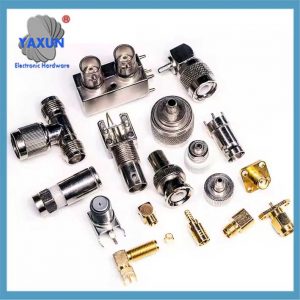
In the RF and microwave industries, many types of coaxial connectors are designed for specific uses and applications, are smaller, and operate at frequencies up to the GHz and millimeter wave ranges. A generally accepted connector standard in the industry. These connectors are compatible with other RF/microwave components and can be used to interconnect with coaxial modules within a system while maintaining the coaxial characteristics of the corresponding transmission line. There are many types of RF connectors with different classifications. How to choose the appropriate RF connector?
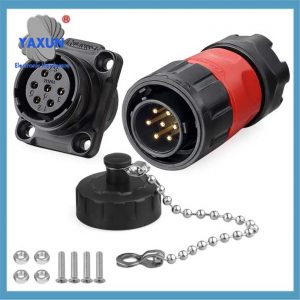 CNLINKO YM-20 Industriële Waterdichte Connector IP68 Ronde Connector Luchtvaart Connector PBT Plastic Shell M20 2-12 Pin-flensaansluiting (7 Pin) |
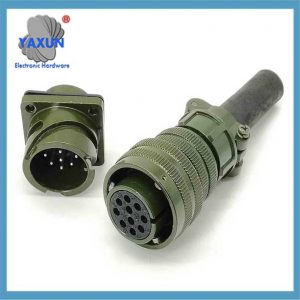 MS3106A18-19 vrouwelijke stekker en MS3102A18-19 mannelijke aansluiting 10-pins MIL-DTL-5015 standaardconnectoren Bajonetserie voor elektronische toepassing Interconnectiesysteem |
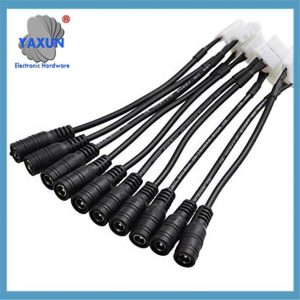 5050 5630 Flexibele LED-lichtstrip naar voedingsclip op connector en DC-aansluiting 5.5×2.1mm-kabel 2 Pins 10 mm brede strip om verbindingsdraad te strippen Soldeerloos |
Soorten RF-connectoren
Volgens de verbindingsinterfacestructuur, het is verdeeld in:
Schroefdraadverbinding:
Gebruik series zoals SMC, SMA, TNC, N, UHF, 7/16 En 4.1/9.5, geschikt voor testapparatuur, militaire en telecommunicatieapparatuur.
Bajonet type:
Gebruik series als BNC en MHV voor een betrouwbare verbinding en snelle plug-in, en worden meestal gebruikt in testapparatuur en militair materieel.
Insteektype:
Het maakt een zeer snelle koppeling en scheiding mogelijk, en de structurele kenmerken ervan zijn betrouwbaar. Het wordt vaak gebruikt in kleine connectoren, zoals MCX- en SMB-serie.
Push-in zelfsluitend type:
Unieke zelfvergrendelende methode, zeer betrouwbaar, meestal op kleine connectoren met hoge dichtheid, zoals 1.0/2.3, 1.6/5.6 serie, snel aansluiten en loskoppelen en betrouwbare vergrendeling.
Inschuifbaar:
Gebruikt in verschillende DIN-multiterminalconnectoren, vaak gebruikt voor aansluitingen op printplaten.
Indeling op grootte:
Standaard type
UHF, N, 7/16, 7mm
klein
BNC, TNC
Ultraklein
SMA, MKB, SMC, MCX, BMA, WEER, 3.5mm
micro
SSMA, SSMB, MMCX, 2.4mm, K (2.92mm), 1.85mm, 1mm
Ingedeeld op frequentie:
Audio: onder 20 KHz
Video (Ik heb het gezien): onder 30 MHz ~ 500 MHz
Radiofrequentie (Radio): 500MHz~300GHz
Optische vezel (Fribre-optica): 167THz~375THz
Connectoren die in de radioband worden gebruikt, worden RF-connectoren genoemd.
Serie op frequentie
Verdeeld volgens beëindigingswijze
Connector MIL-C-39012(GJB681)
Adapter MIL-A-55339(GJB680)
Microstrip and stripline ML-C-83517 (GJB976)
Divided by function:
General type (level 2)
Precision type (level 0, level 1)
Special type (irradiation resistance, high pressure resistance, waterdicht, enz.)
Multifunctional type (including filtering, phase modulation, mixing, verzwakking, detection, limiting, enz.)
RF/microwave coaxial connectors come in several categories. Net als bij coaxkabels, the cutoff frequency is a critical characteristic of any coaxial cable connector and represents the highest frequency at which the desired single TEM propagation mode can be maintained. Het frequentiebereik van elke connector wordt beperkt door de voortplantingsmodi in het overeenkomstige coaxiale systeem. Millimeter wave coaxial connectors refer to coaxial connectors used for frequencies above 18 GHz.
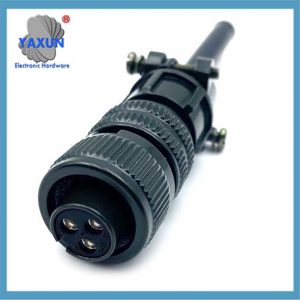 MS3106A10SL-3S Industrial Circular Connector, MIL-DTL-5015 Series Threaded Connector 3 Pin Contacts Solder Female Connectors Straight, 10SL Shell Size |
 Amp 206044-1 Sealed CPC PIN Connector, 14 Position, Straight Cable Mount, 14 Terminal, 1 Port, 34.67 mm L |
 Circular Connector Plug Size 14, 12Pos, Kabel – UT061412SH |
Typ N, BNC- en TNC-connectoren:
The 50-ohm N-type connector was developed in the 1940s and was originally used in military systems operating below 5 GHz. Type N connectors feature an internal gasket with an air gap between the center conductor and the outer conductor. Although subsequent improvements increased its performance to 18 GHz, even the latest designs will start to undergo propagation changes at around 20 GHz. That is, there will be unpredictable consequences when using this type of connector at frequencies of 20 GHz of hoger. De 75 ohm N-type connector is widely used in the cable television industry.
BNC connectors are used for video and RF applications up to 2 GHz, using slotted outer conductors, and both male and female connectors are equipped with plastic dielectrics. Bij hoge frequenties hierboven 4 GHz, slotting can emit signals up to approximately 10 GHz. Omdat de passende geometrie van BNC-connectoren compatibel is met N-connectoren, sommige BNC-connectoren kunnen tijdelijk worden gekoppeld aan N-type connectoren met overeenkomstige polariteit.
TNC-connectoren zijn de schroefdraadversie van BNC-connectoren. Deze versie helpt bij het oplossen van lekkage- en stabiliteitsproblemen en maakt gebruik mogelijk bij frequenties tot 12 GHz en 18 GHz. TNC-connectoren worden veel gebruikt voor RF-/antenneverbindingen in mobiele telefoons.
SMA- en SMB-insteekconnectoren:
De SMA (subminiatuur type A) connector maakt gebruik van een 4.2 mm diameter buitenste coaxiale geleider gevuld met PTFE-diëlektricum. Afhankelijk van de fabrikant, de bovengrensfrequentie is 18 ~ 26 GHz. SMA-connectoren hebben een formaat dat past op een 5/16-inch (12.7/40.6 cm) moersleutel en koppel met 3,5 mm en 2,92 mm connectoren.
Het MKB (subminiatuur B/subminiatuur B) connector is een opsteekconnector, meestal gebruikt in frequenties van 4 GHz tot 12.4 GHz. Omdat mensen steeds hogere frequenties nodig hebben, this type of connector has the problem of being too large and unable to provide the bandwidth required for high-frequency applications.
3.5mm- en 2,92 mm-connectoren:
The two connectors using air media are not only compatible with each other but also with the SMA connector.
The 3.5mm connector can operate stably at frequencies within 26 GHz, while the 2.92mm connector has a maximum operating frequency of 40 GHz.
2.4mm- en 1,85 mm-connectoren:
2.4mm- en 1,85 mm-connectoren zijn compatibel met elkaar, maar hun ontwerp is niet compatibel met SMA, 3.5mm- en 2,92 mm-connectoren. This is because these two types of connectors are more sophisticated and more expensive. If mated with lower precision connectors, it may cause irreparable damage.
1mm- en 0,8 mm-connectoren:
Both connectors are suitable for millimeter wave analysis, supporting transmission and repeatable interconnect applications in the DC~110 GHz range.
Choose the right RF connector:
How to choose the appropriate RF connector can be determined according to the actual application. If you choose purely based on performance, you can judge based on electrical performance indicators.
The main indicators of RF connectors are:
Impedance:
Almost all RF connectors and cables are standardized to 50ohm impedance. The only exception is the cable TV connector for 75ohm TV systems. It is also important that the RF coaxial cable connector has a characteristic impedance that matches the cable.
VSWR (Voltage Standing Wave Ratio):
VSWR is an indicator commonly used by engineers to evaluate RF connectors. It is similar to impedance. Onder normale omstandigheden, the VSWR is guaranteed to be less than 1.2 within the frequency range of interest. But it does not necessarily have to reach 1.2. Some of them meet the requirements if they are below 1.5 of 2. The lower the better, of course, and the cost will be correspondingly higher.
Frequency Range :
The operating frequency range of RF connectors must be paid attention to in the high-frequency and high-speed fields. The frequency is divided into several grades, such as 1~6GHz, or 0~18GHz, 20GHz, 27GHz, 40GHz, 50GHz, 67GHz, 110GHz or even higher.
Insertion loss:
Loss is a metric that all connectors pay attention to. It’s just that usually the loss of RF connectors is relatively small (if it is too large, it means there is a problem). Algemeen, within the frequency range of concern, it is within 0.1~0.5dB.
Return loss:
For some engineers who work on digital circuits, VSWR is not so intuitive, so some use return loss to characterize it.
Number of times of use (plugging and unplugging):
Some engineers may not pay much attention to the number of times a connector is used. This number of uses is generally considered to be the number of times the connector is plugged and unplugged before the performance of the connector changes. Algemeen, the plug-and-pull times of RF connectors are 500 of 1,000 keer, and there are also higher requirements. If you want to do some experiments on this, you have to do it under a specific torque/torque, otherwise it will be difficult to guarantee the number of uses. The connectors I have used generally have not reached this number of times. It is estimated that it has been used 100 of 200 keer, and the internal core has been deformed because it is always possible to insert it crookedly or twist it with too much force.
In addition to the above electrical performance of the connector. Mechanical properties of the connector (fixation of the central contact, mechanical strength of the connector, trillingen, impact, enz.), environmental properties (climate category, sealing, salt spray) and connector durability (mechanical durability, high temperature durability) These are all factors to consider when choosing the right connector. In actual applications, you can choose your appropriate connector based on the above factors.